
 Another easy hiking day along the coast, but more varied than just walking along the beach.
We left Carole and Ronnie for Netanya in two cars. We parked mine at the 4C Biomed office in Netanya close to Netanya Sapir Station and the other we took to Ramat Poleg. This is familiar teritory to me. I often cycle from Herzliya to Ramat Poleg to ride back to Tel Aviv with my brother Leon who is now in Briga Towers – his third Netanya apartment in Ir Yamim.
We hiked along the Poleg stream into Poleg 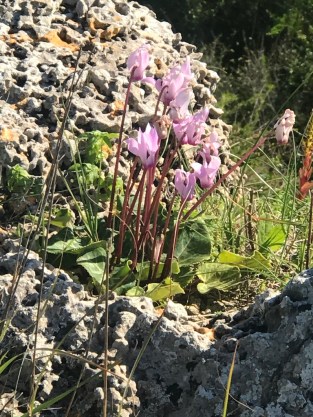 park and along the limestone escarpment that created swamps to the east. The Romans drained those swamps by chiselling a channel through the ridge which is clearly visible.
Walking through the orchards around Udim a local farmer told us of some irises over a small ridge and we made a diversion to see them – along with a local class of schoolkids.
Back on the trail we took a footbridge over Route 2 just south of the Wingate Institute (named after Major General Charles Orde Wingate a religious Christian and supporter of Zionism who set up training of the Hagana) and walked through the Sharon Beach Nature Reserve of dunes and grass parallel to the coast. It was another lovely day and the route was delightful with plenty of birds and flowers and occasionally spectacular coastal views.
At a couple of places along the cliff little white two seater benches overlooked the rocks and sea – apparently popular places for marriage proposals! We scrambled down and then up a deep gully at Gaash and passed by the wealthy community of Arsuf. We ate lunch at the edge of the nature reserve (more purple irises) and made our way to Apollonia (or Arshuf) on the north edge of Nof Yam.
Apollonia was settled by the Phoenicians in the 6th or 5th century BC and was named for Reshef, the Canaanite god of fertility and the underworld. They produced purple dye which was exported to the Aegean. In Hellenistic times it became an anchorage town, and later a Roman villa and glass factory. It fell to the Muslim conquest in 640 and was fortified against Byzantine attacks and became known as Arsuf (Arabic: أرْسُوف ʾArsūf, Latinized Arsur). In 1101 it was conquered by the Crusader Kingdom of Jerusalem, and was a strategically important stronghold in the Third Crusade, during which the Battle of Arsuf (1191) involving Richard I was fought nearby. Richard is also said to have fought a fighting  march down the coast from Atlit to Arsuf. dending off Arab forces harrying him from the east with the sea protecting his west flank.
The fortified city and the castle fell to the Mamluks under Baibars in 1265, when both were completely destroyed after 40 days of siege.[14] The inhabitants were killed or sold as slaves and the town completely razed. The destruction was so complete that the site was abandoned and never regained its urban character – in the 14th century the geographer Abulfeda said it contained no inhabitants.
We walked aound the site for a while and the resumed our hike past the nearby Sidna Ali Mosque just south of Arsuf which was dedicated by Baibars at the site of a saint’s tomb 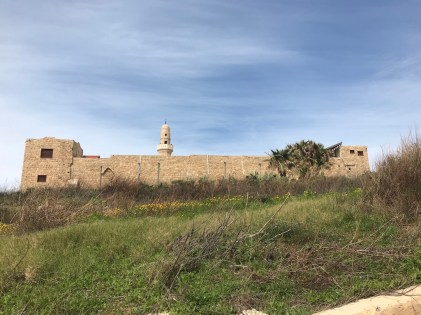 where he prayed for victory prior to retaking Arsuf. From there it was only a couple of kilometres or so to Herzliya Marina where we stopped for the day. We called a taxi to Herzliya station and the train north, Rafi and I getting off to collect the cars at Netanya and Ronnie going on to Binyamina to meet Carole.
Another 65 km under our belts in three days – now to Tel Aviv!
 Hiking the Israel National Trail