
This morning, as usual, at breakfast we packed our lunch in the dining room and left Kibbutz Hakuk – although here they expected you to do that and provided lunch rolls, fillings and bags. The accommodation may have been pretty basic – and the dining room flooded with school kids – but the staff were friendly and it met our needs. (That said, we might try a hotel room again next time…)
Today looked like being our easiest day so far – and so it proved although, particularly for the first two or three hours, we walked in rain, and the amount of thick mud that stuck to our boots was at times ridiculous. So were the lack INT trail markings….
Rafi and Ronnie had waterproof trousers, I didn’t, an error I’ll correct next time. On the first day Ronnie hadn’t worn them, much to his regret when he found he had only one pair of trousers with him and had to borrow a pair of mine whilst washing his when we went to Avi’s for dinner last night. The mud was so thick on my walking trousers each day it was a huge effort to clean them up each evening for the next morning. But enough of the housework…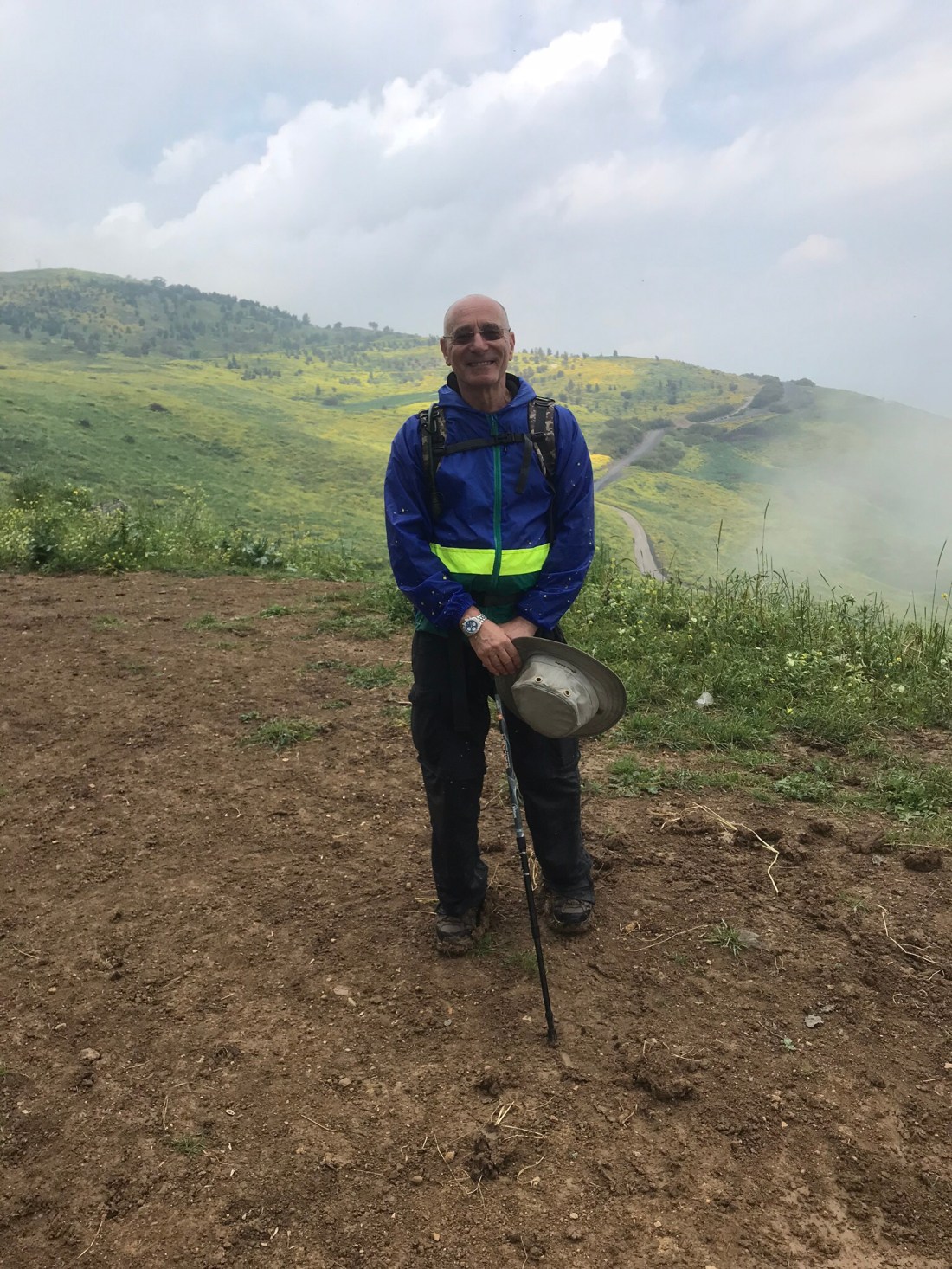
We dropped a car at Yardenit, a baptismal site just where the River Jordan leaves the Kinneret and, early in the day, it was already crowded with groups from around the world preparing to be (re-)baptised. They wore white robes and it was striking how much it 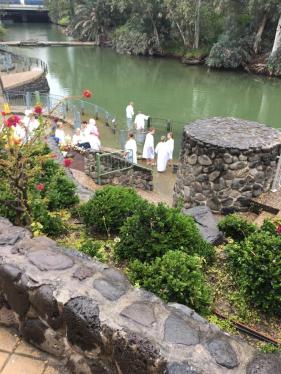 meant to them to be undergoing the ceremony in what was to them such a special place.
Yardenit is not on actually on the Jesus Trail from Nazareth to Capernaum, but Christian pilgrims come to walk that too, and we did come across it for several kilometres of our walk this time, around the Arbel Cliffs and Migdal. It is a 65-kilometre hiking trail in the Galil which connects important sites from the life of Jesus as well as other historical and religious sites.
We drove back along the Kinneret to start our trek and left the petrol station in  Tiberius Illit and walked an easy path through the Switzerland Forest. The Red Guide said we would walk all day with magnificent views of the Kinneret to our left – but the rain and mist obscured them pretty effectively for most of the first two hours.
We saw birds heading north for the spring (notable by its absence at that point), and several Rock Hyrax staring inquisitively at us.
The  butterflies were still around in droves – although wisely not trying to do too much flying. It was only in retrospect that I found out from Eyal Greenberg, CEO of our biotech R&D facility in Netanya, that for two weeks each year
 millions of Painted Lady butterflies pass through Israel on their way from Africa to Europe. Most go to Turkey, Greece and Southern Europe, but some travel as far as the arctic circle and around 10 million to the UK (30 million make the return trip). It can be a round trip migration of up to 14,000 kilometres or 9,000 miles, and it takes six generations of butterfly to make it, travelling up to 100 miles a day! Simply extraordinary!
We left the cycle path we had been following and started to walk along some very muddy farm tracks. Heavy walking but still pretty flat and the flowers, the trees and increasingly, as the cloud cleared and the Kinneret and Golan appeared, the views were just magical.
As we neared the Southern tip of the lake, we started our descent with a brief stop for  lunch before reaching sea level (that is, Sea of Galilee level, 200m below actual sea level). After a period of good signage the trail markers again disappeared for a while, but it was clear we needed to turn right to reach Yardenit and we found ourselves walking through Kinneret, a settlement established in 1908 alongside a training farm – Kinneret Farm – the settlement under the sponsorship of Baron Edmund de Rothschild and the farm of the Palestine Bureau of the Zionist Organisation. The projects were of great importance in initiating the Kvutza communal settlements, such as Degania Alef, Kibbutzim, starting with Ein Harod and Moshavim, starting with Nahalal – all started by pioneers trained at Kinneret Farm.

Indeed, incredibly, Kinneret and the activity of Berl Katznelson lay at the heart of:
- The kvutza type of communal settlement
- Degania Alef, the first kvutza, est. 1909 by pioneers trained at Kinneret Farm
- The kibbutz type of communal settlement
- Ein Harod, the first kibbutz, est. 1921 by pioneers trained at Kinneret Farm
- The moshav type of communal settlement
- Nahalal, the first moshav, est. 1921 by pioneers trained at Kinneret Farm
- The women’s rights movement in pre-state Israel
- Beit Ha’almotor Havat Ha’almot agricultural training farm for women, active 1911-1917 at Kinneret Farm
- The first assembly of women farmers (1914)
- HaMashbir cooperative for the sale of affordable food during World War I, est. 1916
- Tnuva cooperative for milk and dairy products, est. 1926
- Solel Boneh construction company, est. 1921; emerged from the Work Battalion
- Bank Hapoalim workers’ bank, est. 1921
- kupat holim public health care system
- Haganah paramilitary organisation: at the 2nd assembly of the Ahdut HaAvoda party held at the Farm in 1920, the agenda included the founding of the Haganah
The Farm residents also had a major role in establishing and shaping the Histadrut labor union of pre-state Israel.
So far as we could tell by comparison with a sign showing an old photograph of the settlement in 1908, all the original homes were there, plus some others filling in spaces between them, and the quiet atmosphere just a few dozen yards from two busy roads was striking. Unfortunately the small museum (in the former local hospital) and the town hall were closed, but they, the house where many settlers sheltered in the 1929 Arab Riots and other historic sites were marked with blue signs.
We then passed to the east of the village, across the road from the restored Kinneret 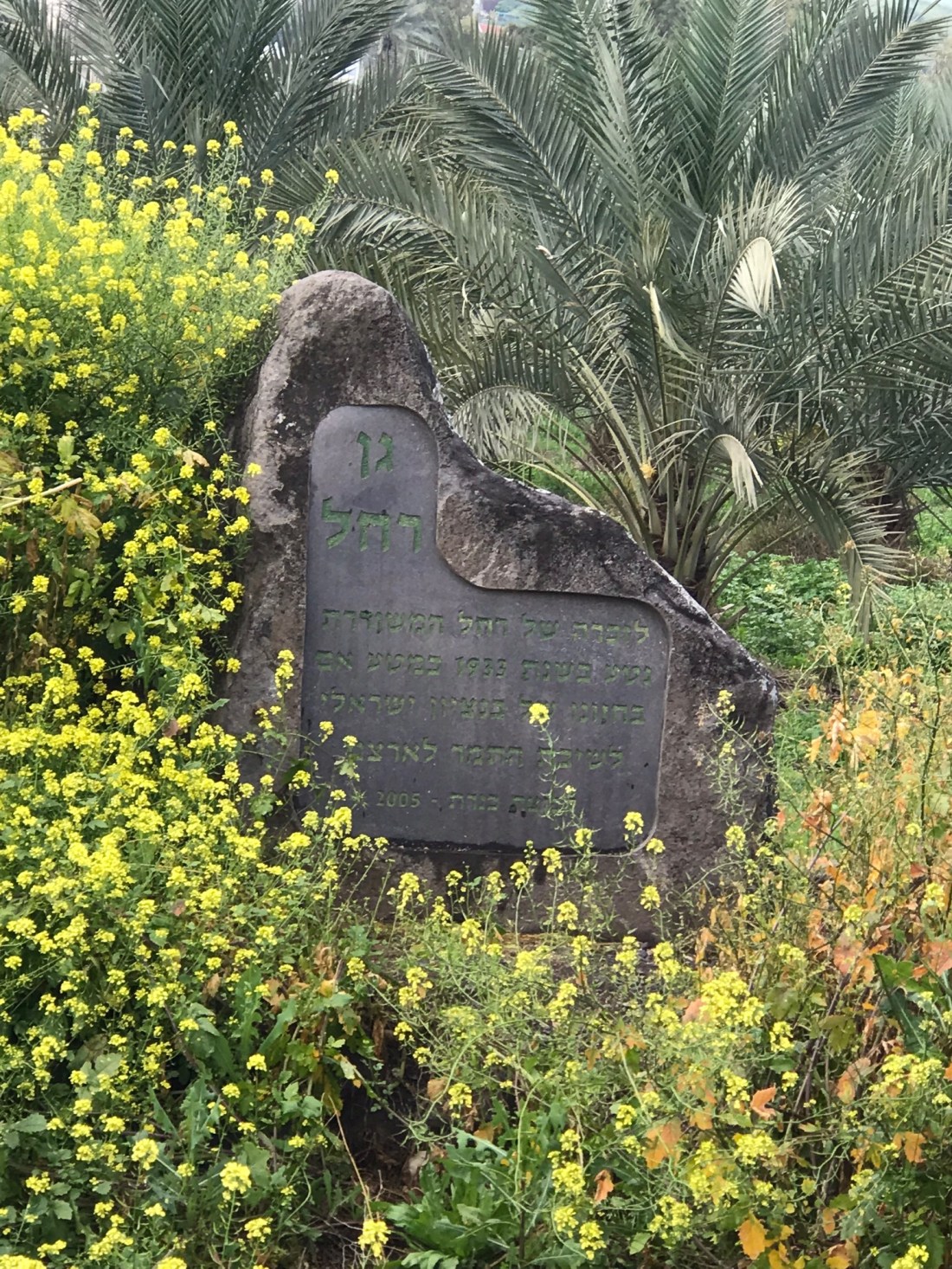 Farm, the historic Kinneret Cemetry where many pioneers and leaders of the Labour movement are buried, among them Berl Katznelson, Nachman Syrkin, Rachel Bluwstein (“Rachel” the famous Hebrew-language poet from pre-state Israel, Ber Borochov, Moses Hess, Avraham Herzfeld and Shmuel Stoller. The first grave was dug in 1911 for Menahem Shmueli (Mamashi).
By early afternoon we had arrived at Yardenit again at the end of our three days’ of treking the Shvil and made our way back to Tiberius Illit to collect the car. We had a farewell drink, Ronnie added his thoughts to the Shvil Log in the small supermarket and we parted company until our next trip scheduled for May. .
I decided to take the opportunity of finishing early and the improved weather to go back 
 to Yesha fort to see the irises. Driving back – 45 minutes of fast driving – I realised how far we had come, but I was out of luck. Despite the guidance of the lady who ran the vineyards at Yiftah to the spot she had seen them a couple of weeks earlier, they had all finished flowering. But perhaps it was for the best; I’ll try and arrange for Ruth and I to see them together next year. The trip was not wasted – the other flowers and the views were spectacular, and with them in mind I started the trip back to Herzliya.
 Hiking the Israel National Trail