
Today dawned a perfect walking day –  the weather was in the high teens, sunny without much wind, warm in the sun and cool in the shade. We expected a relatively straight-forward day but for a stiff climb up the Arbel cliffs, and left the car at a petrol station in Tiberias Illit before going back to pick up the INT where we had left it, a kilometre or two down the road from Kibbutz Hakuk.
We all wore our new Shvil T-shirts, and very smart I thought we looked too.
We continued to follow the Amud stream, but by now we were out of the gorge and in sight of the Kinneret; and whilst we still criss-crossed the  stream four times as it meandered towards the lake. It flowed gently and we were walking an easy straight-ish path.
The flowers grew in profusion, and we started to notice large numbers of butterflies, and later caterpillars – a phenomenum that grew over the next two days. There were distant views of the Arbel Cliffs (with the Horns of Hittin beyond), at times shining green and brown in the sun and at times looking grey and forbidding in the shade of the gathering clouds. Fields and orchards started to appear as we approached the bottom of the rift valley – as well as new homes being built with views to the lake. We chatted to the builders. The homes lay below Migdal where Rafi’s cousin and his accountant have holiday homes with great views over the Kinneret to the Golan.
At one stage we were almost overwhelmed by the incredibly powerful jasmine-like smell 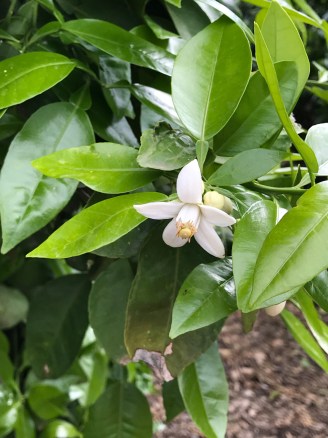 of orange blossom (could have been Pomelo) from an orchard we walked through, and there were mangos and other fruits as we approached the entrance to the settlement of Migdal and reached the banks of the Kinneret itself – or at least Road 90 running along its shore. It was encouraging to see the lake was larger than when I last saw it. The past three months have seen high rainfall and the Kinneret is higher than it has been in at least five years, increasing in depth over the winter by around 3 or 4 metres with a metre or more still to come – which given its gradually sloping shoreline significantly increases the size of the lake.
I stopped at a store on Road 90 to buy some disposable razors (having forgotten to pack one), and then we started to walk south west through a mango orchard towards the Arbel Cliffs – the climb looking more daunting as we approached. The INT here runs parallel to Road 90 towards a Bedouin village, Hamam. Originally built for Mizrachi refugees, and pretty run down, the inhabitants of a number of Arab villages were subsequently moved there and have transformed it.
The grass and flowers were wet, chest high and the path muddy; it made for a damp walk. But at the village we turned left into the Arbel National Park where the cliffs loomed above us dotted with caves. After a break for a snack started our ascent. We were a bit concerned about time and Rafi suggested we aim to complete the ascent in an hour and a quarter.
At first the path was a well maintained zig zag path up an increasingly steep hill – enough to make you breathless but straight forward. However it was relentless and as we climbed it made sense to stop occasionally to catch our breath and to admire the view. It was magnificent.  We could see Hamam spread out before us and you could see it was a village of good homes with a new school, a new mosque and other signs of apparently well-earned prosperity. We heard the midday call to prayer ring out over the valley and could look beyond the village to see end of the Amud gorge and, further to the right, the northern Kinneret and the Golan heights as far as Gamla and Mount Rabin beyond. The scenery was breath-taking.
Looking back to the looming cliffs above, we saw the very steep meadow-like climb ending abruptly in sheer rocky cliffs rising up to another 110 metres vertically (the only place in Israel you can base jump), covered in flowers and looking like the largest dry stone wall and vertical rockery you could ever imagine.
Dug into the mountain itself are a number of cave dwellings, expanded from natural  caves. There are documented Jewish cliff dwellings dating back to the Second Temple, and the fortification walls protecting some of them are from the 17th century and were built by Ali Bek, son of the Druze emir Fakhr ad-Din al-Ma’ani.
Josephus writes about how Herod the Great, with the help of Roman soldiers, defeated some of the last rebels who supported the Hasmonean king Antigonus and had taken refuge in the Arbel cliffs. They lowered soldiers in baskets by ropes from the cliff top to kill the Jewish Zealot defenders
The caves on the steep northern side were reused in the Ottoman period by the Druze Ma’ani dynasty to create the cave castle known as Qal’at Ibn Ma’an.
 After a quick look at the sites we started the serious business of climbing the near vertical cliff face. Fortunately the better weather meant we did not have the mud and slippery rock issues we had in the Amud gorge the previous day, but there was a seriously long drop and the galvanised rings hammered into the cliff at particularly challenging sections, whilst essential, did not dispel the occasional bout of vertigo as we continued the climb to arrive – eventually – at the top precisely one and a quarter hours after we started.
We stopped for lunch by a reservoir at the top, admiring the view, and chatting to an American and Argentine couple we later saw again at dinner, before setting off for what Rafi assured us was a quick two kilometre final leg to the car. Some two Kilometres! The trail to 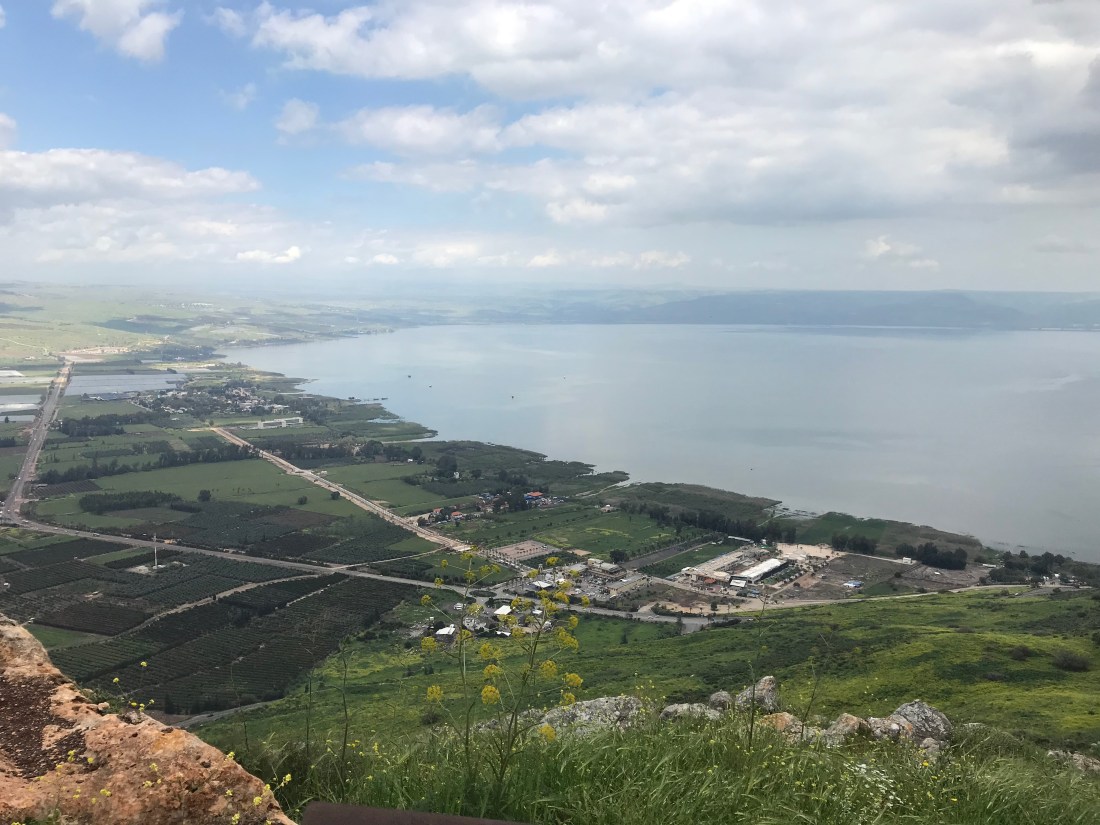 Tiberias Illit took the best part of two hours! But it was not difficult walking and we continued to marvel at the number of caterpillars and – elusive to photograph – butterflies we saw. There were clouds of butterflies – rising from the path at every step, and it was hard to avoid treading on the multitude of caterpillars. I probably drove Rafi
and Ronnie a bit crazy as I kept stopping to admire them.
Eventually, we arrived at the car at around 3:30pm and had a congratulatory beer. The Red Guide said that the mini market at the petrol station kept a logbook in which ‘shvilists’ could make an entry. I asked for the logbook and was handed 4 or 5 random exercise books, neatly bound and numbered. The latest volume was 29. Most entries were in hebrew, but some were in English, remarking on the journey, practical issues and life in general. I made an entry for the three of us and we made our way back to Kibbutz Hakuk.
That evening we were all still tired and chose an early dinner at Avi’s in the centre of downtown Tiberius. The town looked to be a bit smarter than last time I was visited – there is a new and dynamic mayor who is making an impact – and there are certainly enough Christian tourists touring the Galil to improve the economy, as well as a significant growth in the Charedi population.
The food at Avi’s was excellent. I had a huge Israeli salad selection as a starter – enough for the three of us (especially as Rafi and Ronnie had soup as well) – and then we had two entrecotes and a fillet steak between us – the fillet was huge! Avi is a giant of a man and has owned and run the restaurant for 43 years; he was a perfect host. Definitely worth a repeat visit…
 Hiking the Israel National Trail