
It felt a very early 4:20 am start as I had only arrived in Israel and packed for the Shvil the night before. It was also an unpleasant surprise to wake to rain which, based on the forecast on my phone, I had not anticipated.
I’m still refining the list of what to take when I hike (and I also need to find a way of actually remembering to take everything that is on the list). I’ve also concluded I need a complete set of kit in Israel as trying to remember which bits are in Israel and which in London, and what to take from one country to the other each time, is plainly beyond me. In any event I did not have a full set of wet weather gear – something I need to correct based on the experience of the next three days…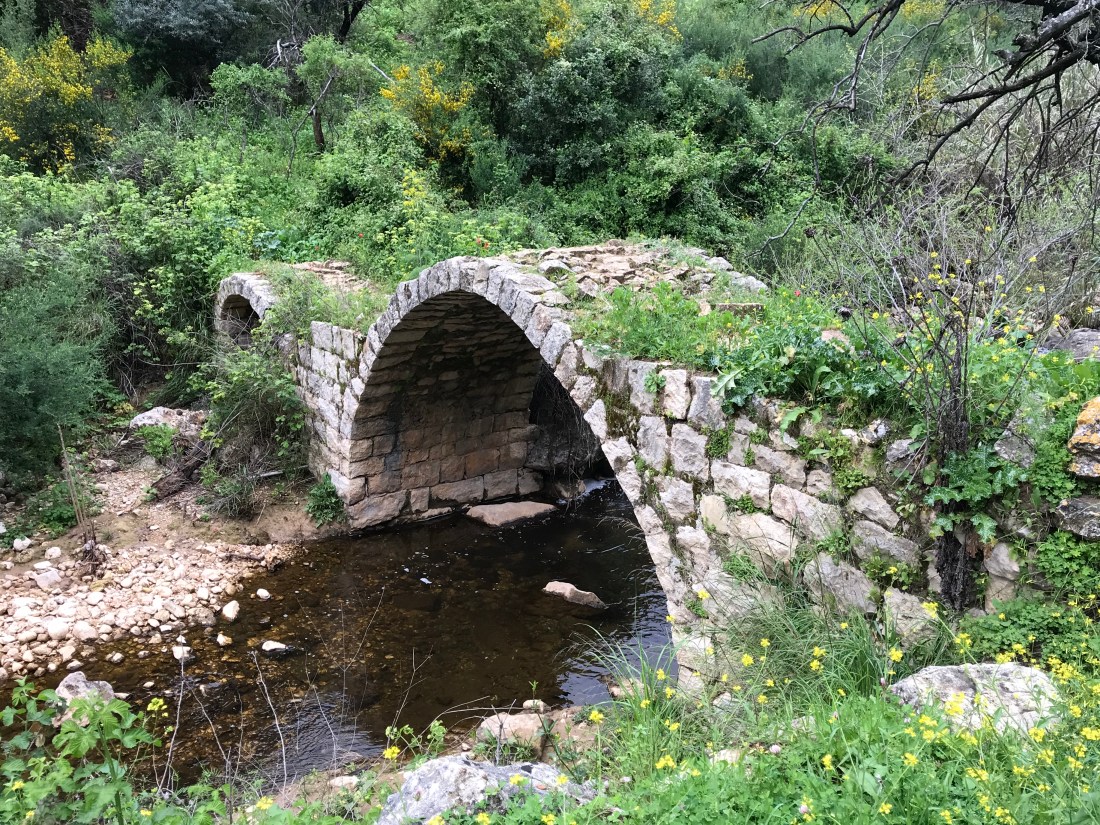
On arrival at Ronnie’s I handed out the Shvil printed T-shirts I had ordered and which we decided to wear the following day. Then we were off on our two-car trick, dropping my Eldan Hire Car – a Citroen C3 – near Kibbutz Hakuk at the end of the Nahal Amud Park and driving on in Rafi’s Forester to Meron, where we had finished our hike a few weeks earlier. We stopped only for breakfast and to buy a sandwich lunch at Roladin in Rosh Pinna. The staff were as ever delightful, and the place had become a favourite.
 By 9.10 am we were on the trail and the rain, though not heavy, came in occasional showers. Of course, at this point I found I did not have my walking pole. I was sure I had brought it, but could not find it in the C3 when we left it. A pity as Nahal Amud was a day that poles would prove their worth… Luckily Ronnie – who had previously looked askance at poles – had become a convert and bought two top of the line poles; I would end up borrowing one.
The first couple of kilometres or so were  easy walking. A gentle downward path beside the Meron and later Amud streams. But, it gave us a false sense of security and optimism the day would be easy; in fact it was to be far from it. Also, whilst walking we picked up the first alert that a rocket from Gaza had hit a home north of Tel Aviv injuring 7, and shortly afterwards heard that thousands of reservists had been mobilised. Sobering.


On the trail that whole day we met only one person, early on, a woman teacher who was walking part of the Upper Nahal Amud to check out that it was a suitable hike for her class. It was up to the Sekhvi pools (though the climb out of the gorge there and a little further on near Ein Koves and Safed – the only places until Road 85 it is possible to get out – is 500m of pretty steep scrambling), but after that things got trickier.
The Nahal Amud gorge is in places narrow and rocky with steep sides. It is split between the Upper Nahal Amud (after we had walked 12km or so) and the Lower Nahal Amud by Road 85 (crossed through a tunnel/large pipe under the dual carriageway). We found ourselves constantly crossing back and forth over the stream, stepping from rock to rock to avoid having to hike in cold, wet footwear. We must have crossed back and forth perhaps 50 times in all – and even assuming each careful crossing (using poles to balance) took the three of us just a couple of minutes or so each time, that still meant two hours or more of lateral movement over the day, significantly slowing our progress.


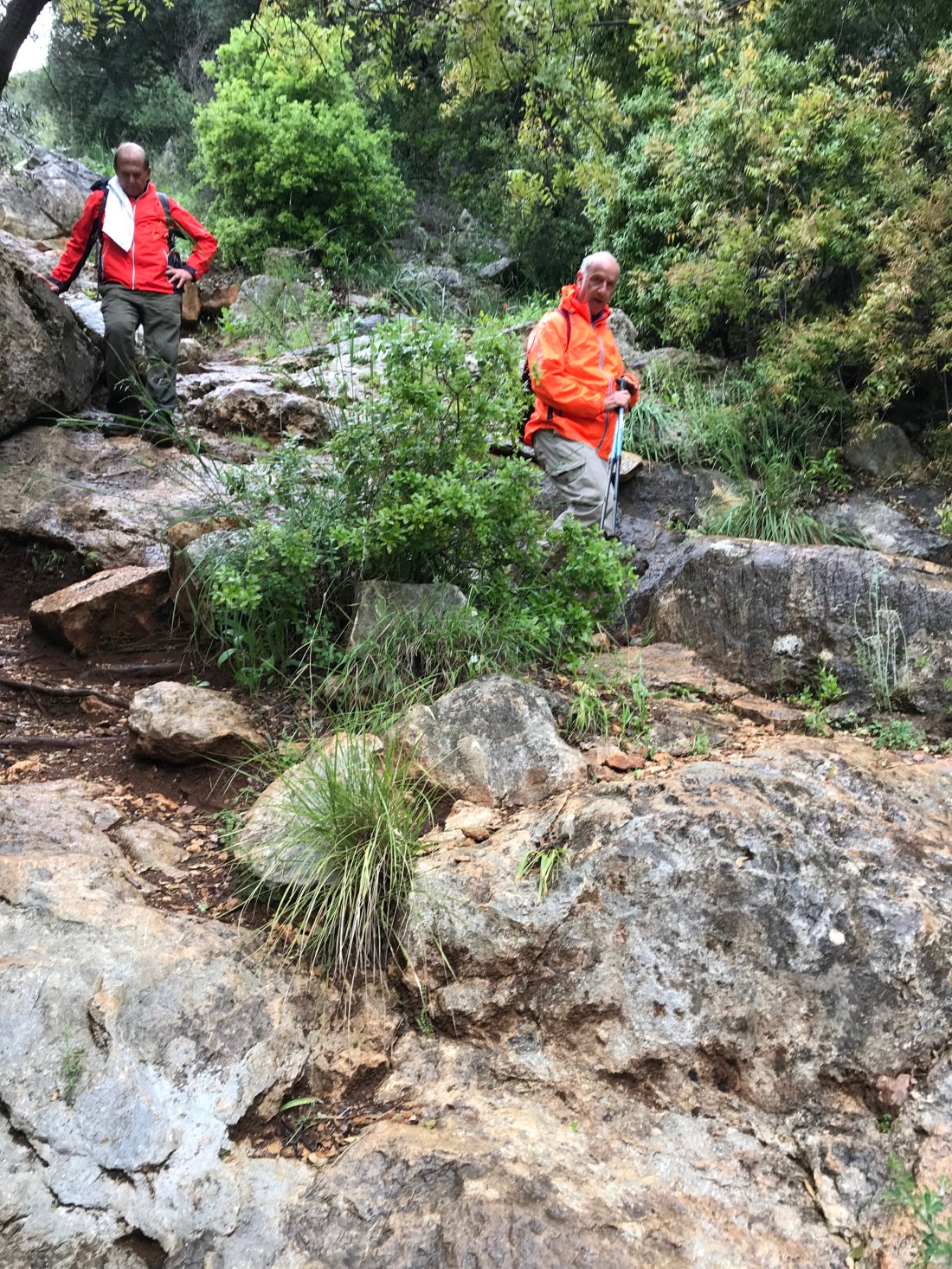
That was not the only problem. At times we had to climb up from the bottom of the gorge to get around particularly sheer rocky banks, and the climbs were challenging as in the rain our boots became increasingly muddy and lacking in grip and the rocks above the gorge increasingly slippery. In places steel handholds had been embedded in rocks to help get around protruding boulders or particularly steep rock faces, but sometimes I’d guess we were up to 15 or 20 metres above the water and a fall would have been potentially catastrophic. This was probably the first really difficult part of the hike – definitely made much more challenging by the weather and the occasional confusing trail marker…. Still, there was little chance of getting lost as the gorge went on, and on, and on – although once or twice we lost the INT markers marking the easiest route over difficult parts of the gorge. On one occasion I scrambled up a particularly challenging part of the gorge, getting very wet and bruised in the process, to find it was not the way forward.
There is a lot to see. The gorge is full of caves, and near the Nahal Amud pillar itself, towards the end of the Lower Nahal Amud, archaeologists have found evidence of Homo Heidelgergensis and Neanderthal man using stone and flint tools. Later, in the Upper Nahal Amud, man harnessed the power of the water to build a series of watermills (originally 26 in all) for making wool and flour, with an aqueduct system to power them;  the remains are clearly visible. There is an interesting background. After the expulsion from Spain, in 1492, Jews brought a new technology to Safed, which helped them to produce good quality woollen cloth. This production process involved beating the wool forcefully (fulling). The Jews of Safed built fulling mills operated by the water power of the Amud stream, which they called ‘batan’ (from the Arabic word for ‘to beat’). The golden age of the Safed fulling mills lasted only three or four generations, after which the mills were converted to regular flour mills in use until the 20thCentury.
At one point it is possible to climb steeply 450 m to the top of Mitzpe Hayamim mountain, one of the few places in the country where from the same spot you can see both the Kinneret and the Mediterranean– a treat we didn’t know about until later, but would have missed anyway in the then poor visibility.
There are also two huge stone stairways, one each side of the gorge forming part of the Israel National Water Carrier. This is the siphon through which the National Carrier crosses the Amud Stream, passing over a 150 m deep channel. In this section, the water is carried through steel pipes. After going down the northern bank of the stream, it then goes up again onto the other bank without the need for any input of energy (the law of communicating vessels). The pipe is some 700 m long, and has a diameter of 3.10 m, and is laid in a channel carved in the cliff, 5 m deep and 10 m wide. The pipe is covered with concrete in the form of stairs.
I was also struck by the profusion of spring flowers everywhere – an extraordinary range and array of colour that followed us throughout our three day walk. Although too late for the height of the iris season, we saw poppies, cyclamen, orchids and much more.


We also heard loud dog-like animal calls apparently signalling in the valley. We guessed jackals or foxes (could have been wolves or wild boar, but sounded more dog like); I suspect jackals – the sound was deeper than a fox bark.
The Amud gorge was also once famous for raptors/birds of prey. The Israel Nature and Parks Authority states: “In 1864 the priest and naturalist Henry Baker Tristram described the nests of hundreds of vultures, several bearded vultures, 
lanner falcons and rock doves on the cliffs of the Amud Stream. In the past, Bonelli’s eagles also nested in thecliffs. Even today, although many of the raptors around the country have been harmed, the cliffs offer an important nesting site. In December 2010, up to 50 vultures were observed spending the nights on the Amud Stream cliffs, as well as other passing birds of prey such as the cinereous vulture and the golden eagle. That year, nine vultures’ nests were built there. Other species of  birds of prey nesting or staying around the Amud Stream cliffs are the long-legged buzzard, the lesser kestrel, the common kestrel, Bonelli’s eagle, the Egyptian vulture, the cinereous vulture, and the snake eagle.”
In the end, we found ourselves running pretty late, and it was eight and a half hours before we finally passed the Amud itself, a limestone pillar 20 m high, and shortly after, some 18km from Meron, reached Road 8077 where we had left the C3 – with my walking pole comfortably nestling inside the boot. Aaargh! It was dark and we were pretty tired before we finally arrived at our accommodation for the next two nights, Kibbutz Hukuk.
The accommodation was simple but adequate – the shower was hot and the supper we dashed straight into unwashed – to avoid hoards of schoolkids about to arrive, wholesome. We didn’t much care. We all crashed out easily that night.
 Hiking the Israel National Trail