
 Our first evening in Beit Oren we had eaten at a pleasant Italian restaurant on the outskirts of Haifa. For our second evening we decided to go to the German Colony and enjoy the nightlife. So, a little bit about the German colony and Haifa…
The German Colony (HaMoshava HaGermanit) (Hebrew: המושבה הגרמנית) was established in Haifa in 1868 by the German Templers. It was the first of several colonies established by the group in the Holy Land. Others were founded in Sarona (then near Jaffa, now in the heart of Tel Aviv) Jaffa, Galilee and Jerusalem. They played an important role in bringing European infrastructure and agricultural techniques to Palestine.


The Templers built their colonies in keeping with strict urban planning principles and introduced local industries that brought modernity to Palestine, which had long been neglected by the Ottomans.
The population of the German colomy in Haifa fluctuated between 300-400 settlers between 1870 and 1914. Employing modern farming methods, the Templers introduced soil fertilization, better methods of crop rotation and new crops such as potatoes. They imported agricultural machinery and engaged in “mixed farming,” combining dairy farming and field crops.
Registering the land was problematic due to back taxes and local boundary disputes, which sometimes turned violent. The Templers thus abandoned farming in favor of industry and tourism. They built hotels, opened workshops and established an olive oil soap factory. The affluent German colony stood out in its poor surroundings. By the end of the Ottoman era the colony had 750 inhabitants, 150 houses and dozens of businesses.
When in World War I General Allenby conquered Palestine from the Ottomans, the German colonists were regarded as enemy aliens. Many of the colonists were recruited for the units of the German Imperial Army, which fought together with the army of the Ottoman ally against the British conquest. The Britons entered Haifa and the colony only after the end of the fighting. Thus the colonists in Haifa were not deported to Egypt, as were the colonists of other, more southern colonies (Jaffa, Rephaim, Sarona, and Wilhelma), which happened to lie in the battle fields.
In 1937, 34% of the Templers were card-carrying members of the Nazi party. On King George VI‘s Coronation Day in 1937, all the Templer colonies flew the swastika flag. At the start of World War II colonists with German citizenship were rounded up by the British and sent, together with Italian and Hungarian enemy aliens, to internment camps in Waldheim and Bethlehem of Galilee. 661 Templers were deported to Australia via Egypt on July 31, 1941, leaving 345 in Palestine.
Many of the old Templer homes have been restored in recent years. Buildings along Ben-Gurion Boulevard (the main thoroughfare) have been turned into cafés, boutiques, hotels, and restaurants, one houses the Haifa City Museum, and the colony has become a center of Haifa nightlife.
As for Haifa today, although Israel’s third city with around 250,000 inhabitants, a 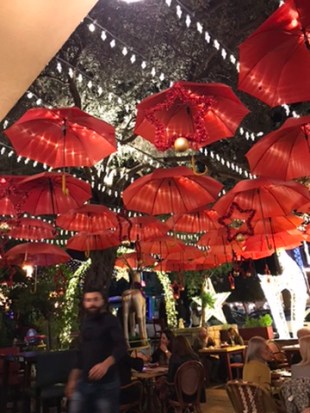
 major port and its scenic location making it an excellent place to live, economically the city has been in relative decline over past decades. More recently major infrastructure investments in the North have improved access, but still the city seems a bit of a (pretty) backwater. Efforts are being made to change this, with hi-tech centres feedingoff the Technion University, and one of Haifa’s great assets is its multicultural nature; it is regarded as a haven for co-existence.
Israeli Jews comprise some 82% of the population, almost 14% are Christians (the majority of whom are Arab Christians)[87] and, some 4% are Muslims (of which 20% are Ahmadis[89]). Haifa also includes Druze and Baháʼí communities. Haifa is the center of liberal Arabic-speaking culture, as it was under British colonial rule. An active Arab cultural life has developed in the 21st century.
Haifa’s diversity was very much on display when we went to what I think was a Druze restaurant in the centre of the German Colony. The streets were festooned with light for the Chanukah/Christmas season and the roundabouts with Hannukiot, Christmas trees and Moslem/Islamic crescents. The pavements were crowded with people of all denominations and none, the atmosphere happy and light-hearted and the noise complemented with the tunes of musicians on street corners. It was just the food that spoilt a wonderful evening…
 Hiking the Israel National Trail