
Breakfast was ready early for us today – as yesterday a friendly informal affair with two young girls (Kibbutzniks?) ensuring we had a sustaining start for the day. We were again alone in the dining room, and Ronnie helped us to hard-boiled eggs and olives for the day.
I can see this is going to be a tradition.
There were initial hints the day might not be quite as hot as the previous two – there was scattered cloud cover – but the heat was as fierce as ever in the sun.
It being Friday we wanted to be back home for Shabbat, so we decided to shorten the trek, to stop 6 or 7 km short of Yesha Fort, and to make up the distance next time. That meant dropping the car at a remote point on the trail where it coincided with a short stretch of secondary road. It was close to an army base and we made sure we parked far enough away not to have it blown up. The Peugeot was still playing up, with a light show of warning lights every so often, but as the previous day we ignored it.
Onward then North to Tel Hai to restart the trek. The further we drove, and the steeper the sharp downward curves we went through, the more worrying the return trip loomed. I was, frankly, a bit nervous – it looked like being a long hot day. We were carrying extra water and so weight, my ankle was aching and the blister on my other 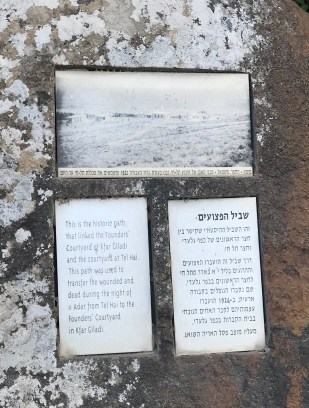 foot hurt. At least the blister evened out the limp. Problem was my memory continued to fail – and now it wasn’t even a different thing I was forgetting each day – it was back to forgetting the walking pole.
The first 2km or so didn’t help; a steep descent along the path the wounded had been
evacuated from Tel Hai 100 years earlier, followed by a much steeper ascent – at least in shade. But, after that, the walking was beautiful; mainly dirt road or broad forest tracks with dappled shade and increasingly stunning views to make up for the fact we were climbing steadily, and at times steeply.
We moved out of the territory of the tribe of Dan into that of Naftali; the steep cliffs we were 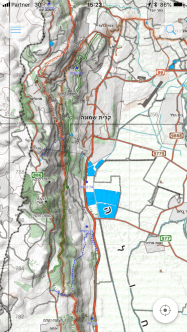 traversing and steadily climbing led up to the Lebanese border and the Lebanese villages we could see close by to our right and behind us. Eventually Lebanon was hidden by steep cliffs and we walked in a land devoid of people – no farms, no villages, just the occasional signs of human impact in the forest – mountain bike runs, other trekking paths, abandoned iron mines, an occasional cattle grid and one cow (odd – no fields or grass), light woodland, and always on our left a steep drop and stunning views of the Hula valley.
Compared to days one and two, the peace was different – quiet forest and muffled sounds rather than more open country. We came across three teenagers also hiking to Yesha, and then a summer camp activity centre in the forest close by the cable car from the valley to Manara with kids mountain biking, climbing, practising archery, and some just playing draughts and chilling out. We were using a lot of water and it was good to be able to replenish our supplies at the summer camp.
By this point the constant climbing was really impacting my tendon and with Ronnie’s help I found a suitable broken branch to use as a walking stick. This worked well, and soon after we were on a long steady part broken tarmac part dirt road up to Mishkenot Haro’im. The road was exposed to  the sun, now high in the sky, and the heat started to become intense, but the views over the Hula to the Golan were magnificent and we made good time, finally moving off the road to a footpath in rocky but green and attractive countryside before reaching the car just before Yiftah, a somewhat truncated day to allow plenty of time to get home for Shabbat.
We drove back to pick up Rafi’s car and headed off home – in convoy in case my Peugeot misbehaved – via (how Israeli of course) a place Rafi knows that he assured us makes the best humous in Israel.
Overall a great three days.
What was good? The scenery was spectacular, the long quiet periods of walking away from people – the INT here is off the beaten track (except when at the entrance to some of the Nature Reserves), the friendliness you so often find in the countryside where the pace of life is slower and people have time for each other, the opportunity to let your mind drift into inner reflection, and the pleasure of just travelling a beautiful country under your own steam at your (or Rafi and Ronnie’s) pace. Everywhere were little museums, archaeological ruins, sites of interest, potential detours – we could only taste a few or we would never have finished.
Most of all the feeling I have always had that Israel is our land, the true Jewish home, just grows as this amazing spider web of interlocking events and histories over millennia, of ancient sites and views, of historic names and of people coming back home from across the world, continues to grow and enmesh you.
What is not so good? For nearly all the first three days we were walking within three miles of the Lebanese border. Lebanese villages were at times just a few hundred metres away – quiet and peaceful in the sun. But Hezbollah positions are clearly there too, just as close, and many of the Israeli kibbutzim, moshavim and towns seem extremely exposed and vulnerable.
The evidence of the history of violence and the terrors of the past are always close by. Whether it be biblical towns crushed by invaders, mediaeval fortresses or more modern historic encounters and losses. Events such as at Tel Hai a hundred years ago; the memorial to the 73 special forces soldiers who died in the 1997 helicopter crash; the poignant photographs left by relatives at the memorial to the 12 paratroopers killed – again at Tel Hai – in 2006 in the Second Lebanese War (how could they have been allowed to gather at a point so plainly exposed to Hezbollah observers and Katyushas?); or the many individual memorials. All along the way at beautiful viewpoints over the Hula and Golan there is tragic evidence of historic enmity and of young men who more recently gave their lives, and of their families torn apart, to protect this narrow finger of land between two enemies looking down in hatred and anger.
 Hiking the Israel National Trail