
The problems we have had in starting our trek early continue. Breakfast was a typical and excellent Israeli kibbutz affair – cream cheeses, grilled vegetables, humous, olives, eggs (boiled and omelettes) and all the rest – but it wasn’t until 7:30am. We were the only guests there even at that time and we were pretty tired after our very early start the day before. So we weren’t on our way from Malkiya until after 8:00am.
We left Rafi’s Forester at the Tel Hai cemetery where Yosef Trumpeldor is buried, and made our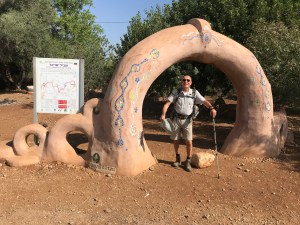 way to Kibbutz Dan to start our trek at the arch that formally marks the Northern beginning/end of the INT. There is a Museum at the entrance to Beit Ussiskin next to the start, but we decided to leave visiting that until our return in the afternoon to avoid the heat.
The walk through the morning was simply beautiful. After just a short distance we reached Tel Dan, a city mentioned in the Bible and described as the northernmost city of kingdom of Israel and belonging to the tribe of Dan. We decided to do no more than take a couple of photographs, planning to revisit the site properly on another occasion. The trail then progressed around the edge of the Tel Dan Nature Reserve with a small tributary of the Dan river crossing our path and Lebanon just a few hundred metres away to our right. We could see Lebanese villages and military listening posts on three sides and Rafi continued to display his 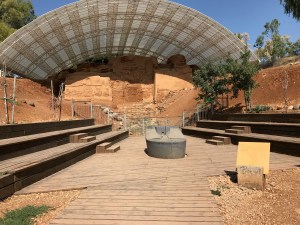
detailed knowledge of the area. A few kilometres in the distance we could see Kfar Giladi, although it seemed to be on wheels as it apparently moved away as the trail weaved towards it.
It was all pretty rural. Lots of cattle grids, though few cows, birds, clusters of beehives and a well-marked, flat and easy trail until we reached the Snir nature reserve.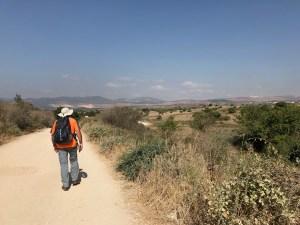
The Snir is the third of the three sources of the Jordan, with the Banias and the Dan, and Ronnie and I got in free with our Israel Nature cards – even though Ronnie’s had expired. But we had not realised that at this point the INT went down the middle of the Snir river, and that meant us each paying a pretty high price for rubber beach shoes at the small shop run by a photographer from Tel Aviv.
The early part of the trail in the reserve was crowded and full of Israeli schoolkids from local summer camps, but as we walked further down the river bed of the Snir the crowds disappeared again and, as before, we felt like the only people on the INT (which, admittedly, in July is not that surprising).
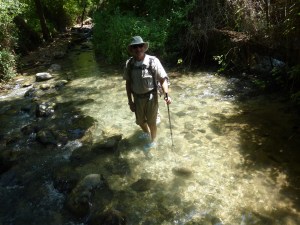 The trail through the Snir was rough and uneven, sometimes we were clambering over rocks and sometimes wading up to our knees – but the water was delightfully cool, and there was plenty of shade from the trees growing along the banks of the river. Where the INT finally left the river we ate the eggs we had taken at breakfast whilst sitting in the shade and then moved on.
At the entrance to Kibbutz Ma’ayan Baruch we found two unspent ammunition rounds and left them at the deserted entrance gate. The INT guidebook told us there is a world-class Natural History museum there but it was getting late and again over 40C and so we decided to press on. Although we were taking time out to see a lot of things along way, there is simply so much to see along the INT that it would take months to walk if you stopped to visit each of the sites.
It remained pretty easy walking, but for the oppressive heat that came up from the tarmac once we hit a paved road, and there was though a final climb up to Kfar Giladi. We arrived at the adjacent Tel Hai cemetery just as the heat of the day peaked, without the long hot afternoon hike of the day before having covered over 22km.
Kibbutz Kfar Giladi was founded in 1916 by members of Hashomer on land owned by the Jewish Colonization Association. The area was subject to intermittent border adjustments between the British and the French, and in 1919, the British relinquished the northern section of the Upper Galilee containing Tel Hai, Metula, Hamra, and Kfar Giladi to French jurisdiction.
After the Arab attack on Tel Hai in 1920, it was temporarily abandoned. Ten months later, the settlers returned. Between 1916 and 1932, the population totalled 40–70. In 1932, the kibbutz absorbed 100 newcomers, mainly young immigrants. Yet, from 1922 to 1948, between 8,000 and 10,000 Jewish immigrants from Syria, Lebanon, Turkey, Iraq, Afghanistan and Eastern Europe were smuggled into Palestine through Kibbutz Giladi, circumventing the British Mandatory ban on Jewish immigration. In an operation known as Mivtzah HaElef, 1,300 Jewish children were smuggled out of Syria between 1945 and 1948. At the kibbutz, the children were dressed in work clothes and hidden in the kibbutz chicken coops and cowsheds.
Tel Hai cemetery, where we had left the Peugeot and finished the trail that day, evoked mixed emotions in me. The story of Yosef Trumpeldor and his roaring lion is inspiring and far enough away in time not to be too personal. In contrast, the memorials to the twelve reservists who died in its shadow when hit by a Katyusha rocket in the 2006 Lebanon war is too recent; the evidence of family loss – fading flowers and photographs – tragic and extremely moving. We noticed the 12th anniversary of their deaths – their Yahzeit – was the following week
 Getting back to Malkiya was pretty easy as the other car in Kibbutz Dan was just a very short drive back. However, our intention to visit the Beit Ussisikin Museum foundered on a petty bureaucratic approach to our attempt to buy senior tickets, and so we made our way back early instead for a swim.
The Kibbutz had a a great little supermarket, and the ladies running it were extremely friendly, offering me bunches of sweet wine grapes, after which I joined Rafi and Ronnie by the pool. As Ronnie observed, there, as with all public swimming pools in Israel, loud pop music seems to be compulsory.
That evening we headed to Dubrovin’s Farm, one of the first farms in the Hula valley, for dinner. It was established by Andrei Dubrovin (1863–1967) who moved to Ottoman Palestine with his family in 1903 from Astrakhan. He and his family were Subbotniks, Russian Christians who kept seventh-day Sabbath. After their conversion to Judaism they took Hebrew names. Andrei became “Yoav”, and his wife became “Rachel”. The family farm, of 650 dunams, was located near a malaria-ridden swamp and two of Dubrovin’s sons and two grandchildren died of the illness. He eventually moved most of his family to Rosh Pinna, leaving behind his eldest son, Yitzhak, to manage the buildings, fruit orchards, and gardens.
Yitzhak bequeathed the Dubrovin Estate to the Jewish National Fund and the farm was converted into a museum that commemorates the early pioneers. Yet, in the grounds of the museum, are the ruins of a synagogue dating between the 4th and 6th centuries, highlighting the historic Jewish settlement in the region. The place is wonderfully atmospheric with an air of history, and the kosher restaurant, run by a young family, is excellent.
 Hiking the Israel National Trail