
We can measure the progress we are making by how much less time it now takes to reach the drop off point for the car. Kibbutz Yagur where we planned to finish the first day’s walk was barely an hour’s drive from my home and I met Rafi and Ronnie at the shopping mall just outside the kibbutz at 7:30am. Nowhere nearby for breakfast, so we grabbed something (and in my case snacks for lunch) at a pretty uninspiring petrol station on the way to the day’s start at Alon Hagalil.
We strode off in pretty decent weather – hazy sunshine and mild. The forecast was for rain later (and again on Thursday, with Wednesday being fine) and so we needed to make good time in the morning to cover the 24 km to Lagur.
All went well for about 45 minutes.
I was striding ahead with Ronnie and Rafi trailing perhaps 100 metres behind. The trail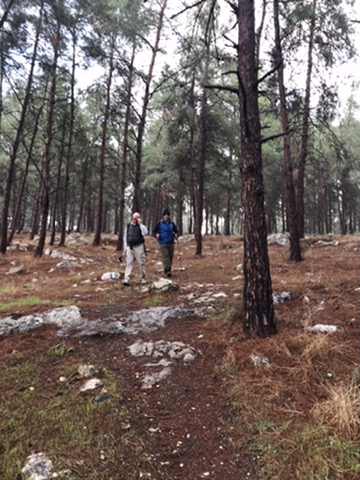 ran along the side of a field uphill to a forest where, after a short clamber over rocks the trail split. I could see INT markers over to the left and followed a quiet pine leaf covered trail upwards with occasional rocky out crops and markers every 25 metres or so. After perhaps 5 or 10 minutes I stopped for Ronnie and Rafi to catch up. They didn’t. After about 10 minutes I called; I called again; I blew my whistle. Silence reigned (apart from the occassional pair of F15s on manouevres). After a while I rang them on my mobile. It turned out they had turned right at the junction and lost the trail. I suggested they go back to the junction and turn left (rule 1 – if you lose your way on the trail, go back to the last marker you passed) but they decided to ‘save time’ going over a small hill to rejoin the trail on the other side.

We finally met up around an hour or so later. Scrambling through woods in roky terrain across country is hard work. My whistle – even when they were in earshot and we ended up 2 or 3 km apart – could not be heard as gunfire in their army years had led to high pitch hearing loss. I sent an email with my exact position and gave an exact map reference (to the maps I had downloaded, laminated and distributed at the beginning of the day), but Rafi’s phone froze so he could not work out where he was. They ended up too far north and in the woods it was hard to see landmarks. When we could each make out a line of date palms or a farmouse on a hill, or a cliff, it turned out there were several of each and we never seemed to be looking at the same landmarks. Aargh! We got back together again in the end but managed only about 3km in the first two hours…
We pressed on and kept up a good pace as the sun broke through strongly and we stripped down to T shirts. The countryside was pretty and the path good as we walked 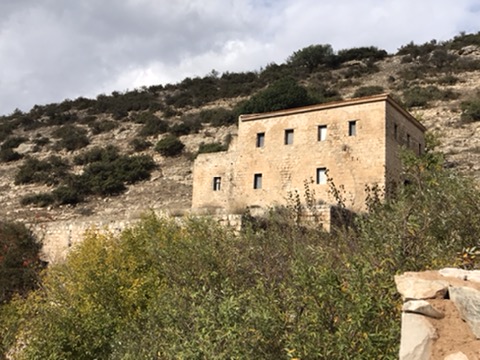 beside a stream to Hanezirim Mill (Monks’ Mill, owned by the Vatican). But even that was less than half way to Yagur, sunset was only 3 or so hours away and the weatehr showed signs of getting worse.
By 2pm it was raining, and the rain was soon heavy. We change into our waterproofs by the Alonim Nature Reserve and pressed on, but some of the climbs were steep, rocky and increasingly slippery as we crossed Route 762 and entered the Shaar Haamakim Nature Reserve. The problem was exacerbated because there were some pretty muddy areas too, and the mud you picked up on your boots meant no grip on the rocks.
It was hard work, and coming down the steep descent towards the Kishon Valley and

Yagur was tricky. Fortunately we hit the valley well before dark, but dusk fell as we walked through the religious settlements of Kfar Hanoar Hadaty and Kfar Hassidim, under Route 70 and to Yagur.
We were muddy. We hosed our boots down in the stables there, collected the other car and made our way to Beit Oren (‘home of the pine’) for the night
In 1934 a single Arab house stood on the site of what is today Beit Oren. It was purchased with the surrounding lands, settled by a group of 15 Jewish workers, and served as a watch tower and camp. The workers intended to build a city and name it Ya’arot HaCarmel, but a number were killed when the site was attacked during the 1936 Arab Revolt.
The kibbutz was founded in 1939 by immigrants from Poland and Russia, part of the Hebrew Socialist Youth movement. Over time these were joined by other groups from Dror and Aliyat HaNoar, as well as by a group from Kibbutz Ma’agan Michael.
During the Mandate era the kibbutz served as a Palmach base for underground activities against the British. On 9 October 1945, a Palmach unit set out from Beit Oren to free 208 illegal immigrants detained at the Atlit detainee camp. After overcoming the guards, the freed immigrants were led past Beit Oren to Kibbutz Yagur, where they were hidden from the British. The attack was the first anti-British action undertaken by the Palmach.
When Ronnie was 11 in 1961 his mother and her new husband brought him here for their honeymoon.
During the 1980s Beit Oren suffered severe financial problems and many of the middle aged members left, leaving the senior members with debts and no income or means of subsistence. The kibbutz movement stopped financial support to the kibbutz, and a group of young individuals were brought in to make fundamental changes. In 1999, eight members of Beit Oren petitioned the High Court of Justice to abolish the classification of Beit Oren as a kibbutz and classify it as a community village.

Beit Oren after 2010 fire
Beit Oren suffered extensive damage in the 2010 Israel forest fire, which claimed the lives of 41 people and burnt thousands of acres of forestland.
In 1942, Beit Oren opened a guest house which became popular among Europeans seeking respite from the summer heat in other parts of the country. The Beit Oren Hotel, still in operation, was where we stayed. It has 30 rooms, a yoga center and a swimming pool.
We settled into our typical kibbutz rooms and then drove into Haifa for dinner. As we descended from the Carmel Mountains the nightime views of the city – as far as Akko – were spectacular.
 Hiking the Israel National Trail